Maximum efficiency and smooth operation are two key factors for applications using DC-motors. Meeting both requirements isn’t always as easy as it seems, for example when it comes to driving precious metal commutated DC-motors with pulse width modulation (PWM).
This tutorial explains which factors have to be considered in the selection and design of a FAULHABER DC-motor, in order to achieve its maximum service life at a high level of efficiency.
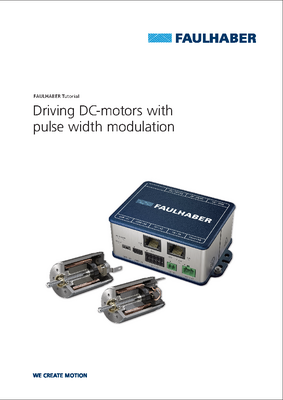
Not every type of DC-motor meets the requirements for operation with pulse width modulation (PWM). If you want to use PWM with a DC-motor with precious metal commutation, several factors need to be considered in order to ensure that your drive system achieves its maximum service life time.
Below you will find out:
2. Why the addition of a C-PCB is useful to prolong the service life of a DC-motor.
3. Why use PWM and what is considered when using PWM with a FAULHABER motor.
5. Which factors need to be considered in the selection and operation of a DC-motor.
All motors in the FAULHABER brushed DC-motor portfolio are based on the technology of the ironless, progressive, self-supporting, skew-wound winding, which was invented by Dr. Fritz Faulhaber Sr.. A DC-motor converts direct current into mechanical energy. Its most important components are a moving rotor, a fixed stator, and a commutator.
FAULHABER offers different types of brushed DC-motors. Depending on the motor technology, they use different mechanical commutation systems: Copper graphite commutation and precious metal commutation.
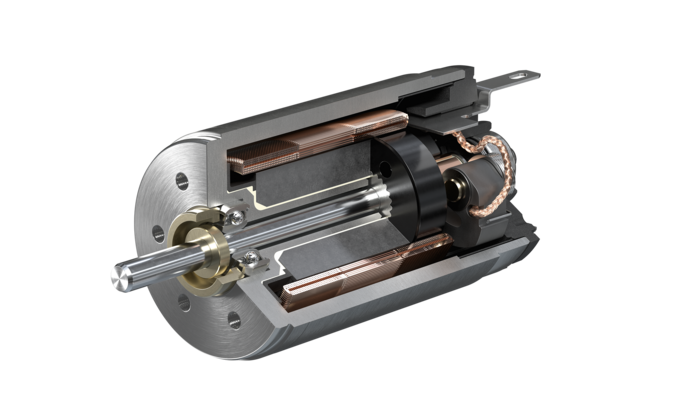
The term copper graphite commutation refers to the graphite material of the brushes, which are used in combination with a copper alloy commutator. This type of commutation system is very robust and especially suited to dynamic high power applications with rapid start/stop operation or periodic overload conditions.
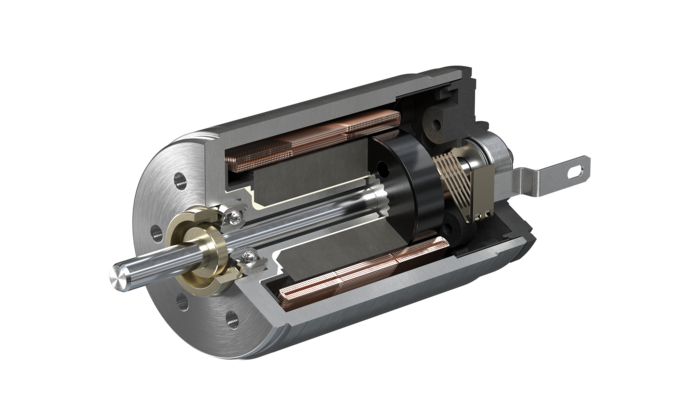
In the case of precious metal commutation, the brushes and the commutator consist of high performance precious metal alloys. This type of commutation system is used mainly because of its very small size, low contact resistance and the extremely precise commutation signal. Precious metal commutation is particularly well suited for low current applications such as battery operated devices. In general, precious metal commutated motors exhibit the best overall performance at continuous duty with a load at or around the point of maximum nominal efficiency.
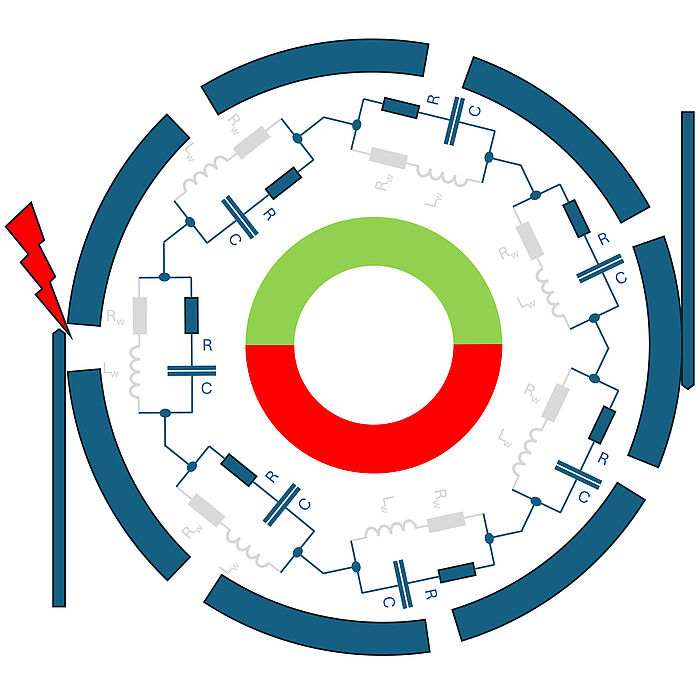
In brushed DC-motors, every time a brush leaves a commutator segment, the current running through the coil is suddenly interrupted. Because the winding is inductive, this interruption causes a high voltage spike and an arc at the brush. The high level of frequency or electrical noise generated can be observed as EMI (electromagnetic interference). Even though arcing can be common in DC-motors (because of the periodic current interruption during mechanical commutation), especially in precious metal commutated motors it can damage the metal brushes and commutator segments by electro erosion. This could result in increased wear and therefore lead to a reduced lifetime of the mechanical commutation system.
In order to prolong the lifetime of a DC-motor with precious metal commutation, an RC circuit is usually placed between neighboring commutator segments to act as a small high-pass filter. So when the contact opens, the motor current switches over to the RC-network, which charges quickly, as the current is no longer interrupted but dampend by the RC.
FAULHABER DC-motors with precious-metal commutation are equipped with so called C-PCBs as a spark reduction component. These C-PCBs are designed as an RC network and can be precisely matched to the rotor winding. They protect the brushes and the commutator from electro erosion. This leads to a longer lifetime and improved EMI
properties.

To control the voltage applied to a DC-motor, the FAULHABER Speed Controllers and Motion Controllers are usually using pulse width modulation. PWM is a very efficient way to drive high loads with very low losses in the output driver of the controller, compared to a linear output stage.
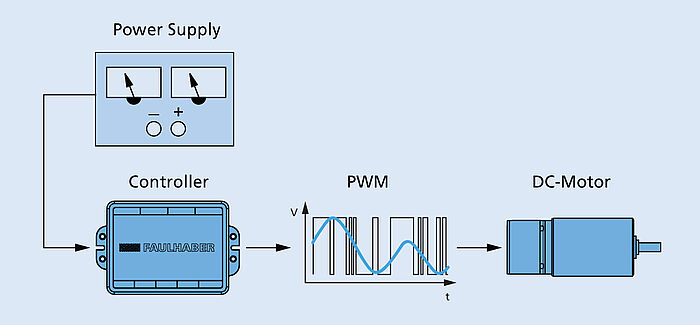
A PWM signal has a rectangular shape with a modulated duty cycle, where the duty cycle determines the needed average voltage at the output of the controllers to change the speed.
There are two possibilities to generate a PWM signal:
Due to their ironless coil design, FAULABER motors have a significantly lower electrical time-constants, compared to slotted motors. This is why there are a few things to consider when operating these motors with PWM. Ideally, the motors should be combined with FAULHABER controllers and FAULHABER accessories, because these components are designed to optimize the system performance.
When DC-motors are driven with PWM, the PWM causes a motor current ripple (red curve in Fig. 6). The motor current increases in a sawtooth pattern inhibited by the electical time-constant of the motor. This is called current ripple.
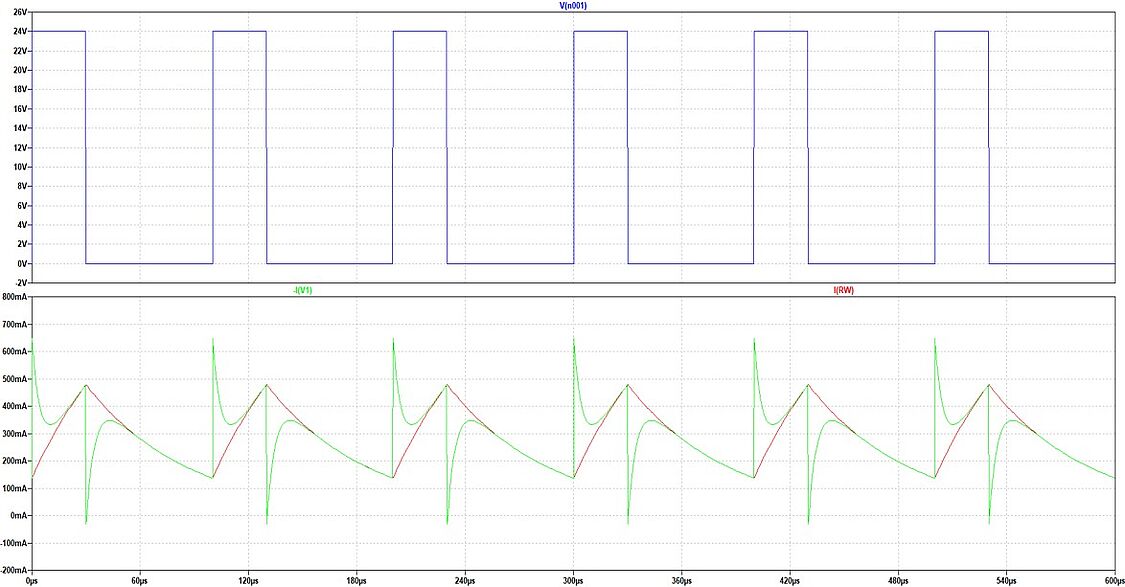
In precious metal commutated motors (e.g. FAULHABER SXR family), there is an additional current peak, leading to the green curve in Fig. 6, which is caused by the capacitor on the C-PCB. These peaks are critical and can lead to the destruction of the C-PCB and the commutation system. The current ripple and the current peaks generate additional losses in different components of the motor (coil, iron, C-PCB, …) and thereby reduce its efficiency.
Normally, FAULHABER motor controllers use a high PWM frequency (e.g. 100kHz) to reduce the current ripple of motors with an ironless coil and a low electrical time constant (L/R), but for motors with a precious metal commutation system with C-PCB, the use of PWM is not recommended because the PWM leads to inadmissible losses in the C-PCB, which are increasing with the PWM frequency (red curve in Fig. 7). In addition, four-quadrant PWM results in higher losses than two-quadrant PWM.


This means that if no additional protective measures are taken, precious metal commutated DC-motors like the FAULHABER SR and SXR motor families are not suitable to be driven with PWM.


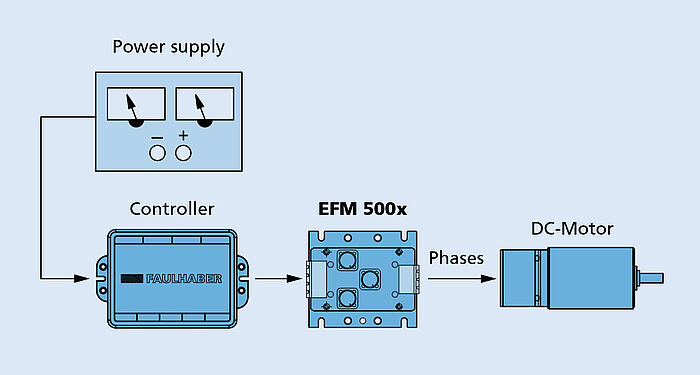
As previously shown, driving DC-motors with integrated C-PCB with PWM in a closed loop application with Motion Controllers or Speed Controllers causes additional stress for the components. To avoid damaging the integrated C-PCB in the FAULHABER SR and SXR motor families, FAULHABER EFM filters should be used (Fig. 8). These filters are using series inductors to create a low pass filter, which, in combination with the motor, prevents harmful current peaks.
Optionally, it is possible to use additional inductors in series to the motor connections. Typical values are 1 … 2 times the motor inductance specified in the motor data sheet. Please consider that additional inductances reduce the dynamics of the drive.
By applying these measures, motors with a precious metal commutation system are reliably protected from damage caused by PWM (Fig. 9).


If it is not possible to adhere to these measures in a specific application, the use of a motor with a copper-graphite commutation system (e.g. FAULHABER GXR family) or a brushless DC-motor should be considered.


The following FAULHABER accessories have a built-in filter which can protect precious metal commutated motors with C-PCB from damage while operating by PWM:



The following application notes from FAULHABER offer further information about driving DC-motors with PWM, connecting DC-motors to controllers and the selection of additional inductances.
To ensure that your application runs smoothly and without issues at all times, it is important that the used drives operate reliably throughout their entire service life.
Our drive system experts have compiled a list of recommendations for the selection of motors in order to achieve the best possible service life for FAULHABER SR, SXR and other DC-motors from the portfolio.
1. In the selection of a suitable motor make sure to choose one that is not constantly operated at its thermal limits. Avoid continuous operation close to the rated load. For example, only use approximately 60-70%.
2. Refer to the motor‘s technical manual during installation.
3. Do not operate the motor without additional protective measures such as PWM filters or series inductance on PWM.
4. Ensure the best possible heat dissipation for the installed motor.
5. Choose a sufficiently high PWM frequency to operate the motor.
6. Use the available current limiting measures in combination with a suitable FAULHABER Speed Controller or Motion Controller.
7. Avoid wear-inducing operating modes if possible (e.g. start/stop; overload; reversing operation; …).
Would you like to learn more about the use of PWM with a specific product or where to find the corresponding values in a data sheet? Or do you need help with the selection of the right DC-motor for your project?
The FAULHABER sales engineers are happy to support you. Let us work together to find the optimal solution that meets the specific requirements of your application.
